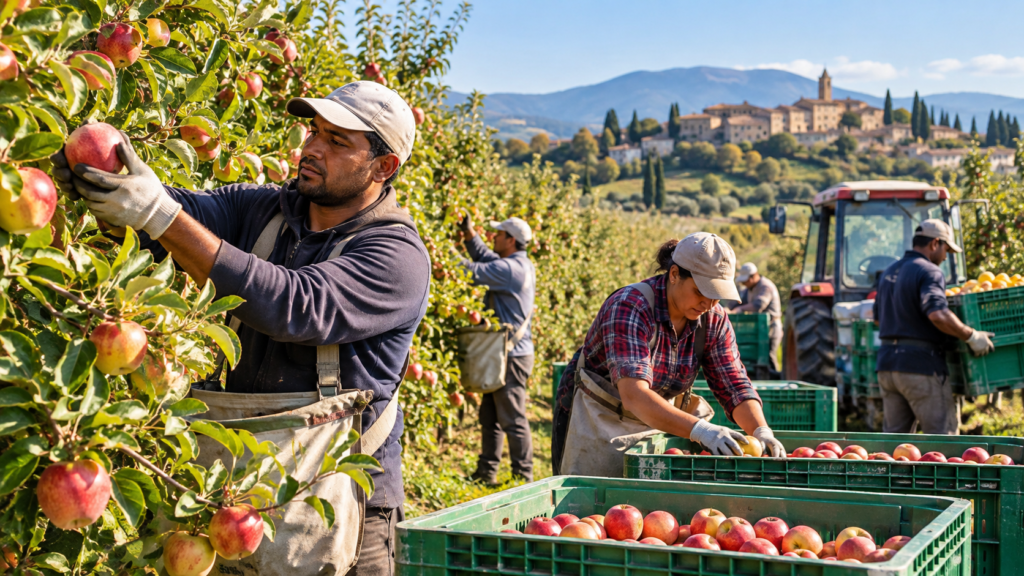
Italy’s seasonal agricultural employment program remains an important legal route for eligible foreign workers seeking temporary employment on farms, in vineyards, and across the country’s agricultural sector.
On January 12, 2026, the Italian Ministry of Labour announced an initial allocation of 40,075 agricultural seasonal-work entry quotas under the Decreto Flussi program. The development demonstrated the scale of the country’s regulated seasonal migration system, although a quota allocation does not guarantee an available job or an approved visa.
For applicants outside the European Union, understanding how this program works is essential. A job offer alone does not automatically authorize someone to work in Italy. The employer, immigration authorities, and Italian consular services each have distinct responsibilities.
This Italy Farm Jobs 2026 – Seasonal Agricultural Work and Visa Guide explains the available types of agricultural work, employer requirements, application stages, expected employment conditions, and important precautions for international applicants.
Quick Answer: Can Foreigners Apply for Italy Farm Jobs in 2026?
Yes. Eligible non-EU nationals can pursue seasonal agricultural employment in Italy through the Decreto Flussi system, subject to nationality rules, available quotas, a genuine employer, and immigration approval. The Italian employer normally requests work authorization before the worker applies for an entry visa through the appropriate Italian diplomatic mission.
Key Takeaways
- Seasonal farm employment can include harvesting, crop care, greenhouse operations, and other agricultural activities.
- The 2026 agricultural click day took place on January 12, 2026.
- Applications under the 2026 program may continue until December 31, 2026, subject to remaining quotas and applicable conditions.
- An Italian employer normally initiates the work authorization request.
- The nulla osta is not itself an entry visa.
- Applicants should verify employers, contracts, wages, and accommodation arrangements before making financial commitments.
The official 2026 program permits submissions after the initial click day, subject to quota availability.
A Realistic Example: How a Foreign Worker Could Obtain a Seasonal Farm Job
Consider a fictional applicant named Daniel, a 28-year-old agricultural worker living outside the European Union.
Daniel has previous experience harvesting vegetables and working in greenhouses. He wants temporary employment in Italy but does not have an Italian work permit.
His situation illustrates how a legitimate application could develop, from identifying an employer to arriving in Italy.
This is an illustrative scenario, not a reported case or a guarantee that any particular applicant will qualify.
Finding Agricultural Employment in Italy
Daniel begins by identifying agricultural employers that may need seasonal workers.
Italy has diverse agricultural activities, and different crops require workers at different times of the year.
Vineyard and grape-harvesting work
Tasks may include picking grapes, sorting produce, maintaining vines, and assisting with harvest operations. Work is concentrated around the relevant regional growing season.
Fruit-picking jobs
Workers may harvest apples, citrus fruits, peaches, and other crops. Physical stamina and the ability to follow safety instructions are important.
Greenhouse and vegetable farming
Work can involve planting, pruning, harvesting, sorting, packing, and maintaining growing areas.
Other possible roles include olive harvesting, nursery work, and agricultural packing operations where the employer’s activity and proposed position qualify under the relevant rules.
Lesson from Daniel’s search: Not every job labeled “farm work” qualifies for a seasonal entry authorization. The actual employer, job classification, and immigration rules must match.
Checking Eligibility for Italy Seasonal Farm Jobs
Before submitting applications, Daniel needs to understand the requirements for non-EU workers.
Italy’s seasonal migration system operates within legally established entry quotas. Eligibility can depend on the applicant’s nationality, the type of work, the relevant decree, and whether the employer can satisfy the legal requirements.
| Requirement | What applicants should understand |
|---|---|
| Nationality | Eligibility depends on the countries and categories covered by the applicable program |
| Passport | A valid travel document is required |
| Employer | A genuine Italian employer willing and legally able to hire |
| Job offer | Employment terms must comply with applicable rules |
| Work authorization | Normally requested by the employer |
| Entry visa | Required where applicable before travel |
| Residence formalities | Must be completed after entry under the relevant rules |
Applicants should not assume that every nationality automatically qualifies for every quota category.
Do Applicants Need Previous Farming Experience?
Previous agricultural experience can improve a candidate’s suitability, especially for physically demanding or specialized work.
However, there is no universal rule that every seasonal farm position requires a particular number of years of experience.
An employer may accept applicants with basic skills for some tasks while expecting previous experience for machinery operation, crop management, or other specialized responsibilities.
Is Italian Language Proficiency Mandatory?
There is no universal Italian-language certificate requirement for every seasonal agricultural position.
Individual employers may still require basic Italian or another shared language to communicate instructions, understand safety procedures, and work effectively.
Learning common agricultural vocabulary before departure can be valuable even where a formal language qualification is not requested.
Understanding the Decreto Flussi 2026 System
Daniel discovers that the Decreto Flussi program is central to the recruitment of many non-EU seasonal agricultural workers.
This system regulates entry for specified categories of foreign workers within established quotas.
The Italian government published the 2026–2028 framework in 2025, with separate administrative procedures and submission dates for different employment categories.
Important 2026 Dates
| Date | Official development |
|---|---|
| October 23–December 7, 2025 | Initial application pre-completion window for the 2026 program |
| January 12, 2026 | Agricultural seasonal-work click day |
| January 12, 2026 | Initial allocation of 40,075 agricultural seasonal-work quotas |
| April 28, 2026 | Additional territorial quota allocation for agricultural seasonal work |
| December 31, 2026 | Stated end date for submitting 2026 applications, subject to quota availability |
These dates are especially relevant to applicants reading the article later in 2026.
The January click day has already passed. That does not necessarily mean every possible 2026 application is closed, but quota availability and the applicable filing conditions must be checked.
What Is the Nulla Osta?
The nulla osta is the Italian work authorization issued through the competent immigration process.
For seasonal agricultural employment, the employer generally submits a named request to the relevant Sportello Unico per l’Immigrazione.
The Italian Interior Ministry explains that this office handles employment authorization requests within the Decreto Flussi framework.
A worker should distinguish three separate documents:
- Employment contract or offer: Describes the proposed job and employment conditions.
- Nulla osta: Provides the relevant work authorization when approved.
- Entry visa: Permits travel for the approved purpose, subject to the visa decision and entry requirements.
Receiving one document does not automatically guarantee the others.
Finding a Genuine Italian Farm Employer
Daniel now searches for legitimate employers rather than relying on social-media advertisements promising immediate visa approval.
His starting points should include recognized employment services, employer websites, and verifiable recruitment channels.
Where to Search for Farm Jobs in Italy
| Platform | Purpose |
|---|---|
| EURES | European employment network and job information |
| Cliclavoro | Italian government employment information |
| Indeed | General job search; employer verification still required |
| LinkedIn Jobs | Employer recruitment listings and company research |
| Italian agricultural company websites | Direct information about employers and recruitment |
These are places to investigate opportunities, not a verified list of employers currently offering seasonal visa sponsorship.
Useful Italian-language search terms include lavoro agricolo stagionale, raccolta frutta, operaio agricolo, and vendemmia.
How to Verify an Employer
Before sharing sensitive documents or making payments, Daniel checks whether the company has a credible business identity, genuine contact information, and a clearly described job.
He asks for written details covering the work location, employer identity, contract duration, expected hours, gross wages, accommodation arrangements, and applicable deductions.
An employer should also be able to explain whether they intend to initiate the necessary immigration procedure.
Warning signs: Requests for payment to guarantee a quota, promises of visa approval without official processing, instructions to enter on a tourist visa and work illegally, or refusal to identify the actual employer.
How the Italy Seasonal Work Visa Application Works
Once Daniel has a genuine prospective employer, the process moves from job searching to immigration administration.
Employer identifies and selects the worker
Employer submits the required authorization application
Authorities examine the request and applicable quota
Nulla osta issued if approved
Worker applies for the appropriate visa and travels if approved
The official seasonal employment procedure is employer-led. The worker does not normally initiate the employer’s authorization request independently.
Documents Applicants May Need
The exact requirements depend on nationality, consular jurisdiction, and the individual application.
Commonly relevant documentation can include a valid passport, visa application form, compliant photographs, employment-related authorization details, and any additional supporting evidence requested by the Italian mission.
Applicants should consult the Italian embassy or consulate responsible for their country of residence before preparing a final document package.
Do not purchase non-refundable flights or assume a visa has been approved merely because an employer reports that an application was submitted.
What Salary Can Italy Farm Workers Expect?
Salary is one of the most important factors for international applicants, but there is no single nationwide monthly salary that accurately describes every seasonal agricultural position.
Pay can vary according to provincial and sectoral collective agreements, job classification, hours worked, experience, overtime, and the actual contract.
| Pay factor | Why it matters |
|---|---|
| Hourly or contractual rate | Determines basic gross compensation |
| Hours worked | Seasonal workloads may vary |
| Overtime | Subject to applicable contractual and legal rules |
| Tax and contributions | Affect net take-home pay |
| Accommodation costs | May reduce money available for savings |
| Transport and food | Can substantially affect living expenses |
A credible job advertisement should specify the wage basis and working conditions rather than promising a large monthly income without explanation.
Gross Salary vs Net Salary
Gross salary is the amount before applicable deductions. Net salary is the amount actually received after those deductions.
Workers should also distinguish employer-provided accommodation from free accommodation. Housing may be offered at a cost or under specific contractual arrangements.
Practical example: If a candidate receives an offer quoting a gross hourly rate, the candidate should request the expected paid hours, applicable deductions, and accommodation charges before estimating monthly savings.
This guide does not assign a fabricated average wage to all Italian farm jobs. Applicants should compare individual offers against the applicable agricultural collective agreement.
Arriving in Italy and Starting Work
Suppose Daniel receives his authorization and entry visa.
His next responsibility is to follow the lawful arrival and residence procedures applicable to his case.
He should coordinate with the employer, retain copies of important documents, and complete the required immigration formalities within the applicable deadlines.
He should also verify that the work performed matches the authorized employment arrangement.
What Workers Should Check on Their First Day
A seasonal worker should understand the assigned tasks, expected hours, pay schedule, workplace safety requirements, accommodation conditions, and whom to contact about employment problems.
Agricultural work may involve heat exposure, repetitive physical activity, lifting, sharp tools, and machinery. Appropriate training, protective equipment, and access to safe working conditions matter.
Workers should never be pressured to surrender their passports to an employer or recruiter.
Can Seasonal Workers Change Employers?
Employer changes, continued employment, and changes in immigration status depend on the worker’s legal circumstances and the applicable rules.
Workers should obtain official advice before changing employers or assuming that their existing authorization automatically covers a different job.
The same caution applies to converting seasonal residence status into another employment category.
What Happens When the Agricultural Season Ends?
Daniel’s seasonal employment has a defined duration.
When the contract ends, he must follow the conditions of his immigration status rather than assume he can remain in Italy indefinitely.
Some workers may qualify for future seasonal opportunities or other legally permitted immigration pathways, but these are not automatic benefits of completing one farm contract.
Workers interested in returning for another season should keep employment records, maintain lawful immigration status, and follow the requirements applicable to future recruitment.
Can a Seasonal Farm Job Become Permanent Employment?
A seasonal job is not itself a promise of permanent employment.
Italy has legal procedures for certain residence-permit conversions, subject to the applicable requirements. The Interior Ministry identifies conversion of seasonal work residence permits among the responsibilities handled by the immigration administration.
Applicants should confirm current conversion conditions through the competent authority rather than relying on a recruiter’s promise.
[Dubai Jobs 2026 for Foreigners – Latest Vacancies With Visa Sponsorship]
The Important 2027 Update for Applicants Who Missed 2026
For people who have not yet found an employer, the next application cycle is particularly relevant.
On October 1, 2026, Italy published operational guidance for the 2027 Decreto Flussi program.
The announcement identifies 89,000 seasonal-work entries across the applicable seasonal sectors for 2027, not 89,000 agricultural vacancies alone.
It also establishes a pre-completion window from October 23 to December 7, 2026, and lists January 12, 2027, among the upcoming click days.
This creates a practical distinction for readers:
- Applicants with employers already pursuing a valid 2026 application should follow their existing case and official quota status.
- Applicants without an employer may benefit from preparing for the 2027 recruitment and authorization cycle.
The 2027 dates should not be confused with the January 2026 agricultural click day.
Common Mistakes That Can Delay an Italy Farm Job Application
A legitimate opportunity can still fail if the applicant misunderstands the process.
One frequent mistake is assuming that a recruiter can issue a work visa directly. Immigration authorization and consular visa decisions belong to the competent authorities.
Another is confusing an entry quota with a guaranteed job vacancy. A quota establishes a possible legal entry allocation; an actual job still requires an employer and successful processing.
Applicants also sometimes overlook contract details, fail to verify company identities, or assume that a seasonal permit provides unlimited employment rights.
Daniel avoids these mistakes by checking each stage separately and keeping written records of communications with the employer.
Frequently Asked Questions About Italy Farm Jobs 2026
Are Italy farm jobs available for foreigners in 2026?
Italy’s regulated seasonal agricultural employment route permits eligible non-EU workers to enter for qualifying employment, subject to the relevant rules and quota availability. This does not establish that a particular vacancy is currently open.
Can I apply for Italy farm jobs without an agent?
Yes. Applicants can search for employers directly. However, the required work authorization is normally initiated by the Italian employer or an authorized representative, not independently by the foreign worker.
Is there an age limit for Italy agricultural work?
Applicants must meet the applicable legal employment requirements. Any specific age-related restriction should be checked against the job, immigration category, and current law rather than assumed from an advertisement.
Do Italy farm jobs provide free accommodation?
Some employers may arrange accommodation, but it is not universally free. Applicants should obtain written information about housing quality, costs, and deductions.
How long does an Italy seasonal work visa take?
Processing depends on the authorization stage, administrative checks, consular workload, and individual circumstances. Published administrative timelines should not be treated as guarantees of visa issuance by a particular date.
Can I apply for Italy farm jobs from Pakistan, India, Bangladesh, or the Philippines?
Applicants from these countries should check whether their nationality and circumstances qualify under the relevant Decreto Flussi provisions and verify the requirements of the Italian diplomatic mission serving their residence. Eligibility should not be assumed solely from the applicant’s nationality or a recruiter advertisement.
Leave a Reply